Textile Sourcing
How to Source Textiles from India: A Buyer’s Guide
India is one of the world's major textile sourcing destinations, but finding the right supplier requires more than comparing prices. This practical guide explains how international buyers can approach textile sourcing from India—from defining specifications and evaluating suppliers to sampling, quality checks, production and export.

Kunwar Satyam Bhadauriya
Director, Rajeshwari Global Hub Private Limited
5 October 2026 · 8 min read

Why Source Textiles from India?
India has a long-established textile ecosystem covering fibres, yarns, fabrics, garments and home textiles. For international buyers, this creates the possibility of sourcing different textile requirements through one market while working with suppliers that can support different product specifications and order requirements. But choosing India as a sourcing destination is only the beginning. The real challenge is finding the right supplier, communicating specifications accurately, validating samples, maintaining quality and managing production and shipment expectations. A low quoted price means very little if the fabric does not meet the required construction, colour, finish, performance or delivery requirements. This guide explains a practical textile sourcing process that international buyers can use when evaluating suppliers in India.
1. Define Exactly What You Need Before Contacting Suppliers
The quality of your sourcing process starts with the quality of your requirement. Before contacting a textile supplier, prepare as much technical information as possible. A supplier can provide a more useful quotation when the product requirements are clear. Depending on the product, your requirement may include:
- • Product type
- • Fabric construction
- • Fibre composition
- • GSM or fabric weight
- • Width
- • Yarn specification, where relevant
- • Weave or knit construction
- • Colour requirements
- • Finish or treatment
- • Performance requirements
- • Quantity or estimated volume
- • Packaging requirements
- • Target delivery timeline
- • Destination country
- • Applicable testing or compliance requirements
You do not need to know every technical term before starting a conversation. However, the more clearly you can describe the end product and its intended use, the easier it becomes for a supplier to understand what you are actually looking for.
2. Choose the Right Type of Textile Supplier
Not every textile supplier is suited to every buyer or product category. Depending on your requirement, you may be looking for a manufacturer, exporter, sourcing partner, private-label supplier or a company capable of coordinating production across multiple stages of the supply chain. When evaluating a potential supplier, look beyond a website or product catalogue. Try to understand what the supplier can actually support.
Questions to Ask a Potential Supplier
- • What textile categories do you specialise in?
- • Can you develop products according to buyer specifications?
- • What fabric constructions can you support?
- • Can you provide samples before bulk production?
- • What quality-control process is followed?
- • What are the minimum order requirements?
- • What production lead times should a buyer expect?
- • Can you support private-label or custom development?
- • What documentation can be provided for export?
- • Can the supplier communicate clearly throughout sampling and production?

3. Request Samples Before Placing a Bulk Order
A photograph or product description cannot fully communicate how a textile feels, behaves or performs. Sampling is therefore one of the most important stages of textile sourcing. A physical sample allows a buyer to evaluate characteristics such as:
- • Hand feel
- • Weight and thickness
- • Colour
- • Surface appearance
- • Construction
- • Drape
- • Finish
- • Stitching or workmanship, where applicable
- • Dimensions
- • Performance against the intended application
If a product needs development or modification, the sampling stage can also be used to clarify what needs to change before bulk production begins. A good sourcing process treats the approved sample as an important reference point for production.
4. Compare Suppliers on More Than Price
Price is important, but it should not be the only factor in supplier selection. A supplier offering the lowest quotation may not necessarily provide the best overall sourcing value. Buyers should consider the complete commercial and operational picture.
| Factor | What to Evaluate | Why It Matters | ||
|---|---|---|---|---|
| --- | --- | --- | ||
| Product suitability | Composition, construction, GSM, finish and intended use | Determines whether the product actually meets your requirement | ||
| Sample quality | Physical sample against specification | Reduces uncertainty before bulk production | ||
| Quality process | Inspection and quality-control approach | Helps maintain consistency | ||
| Communication | Response time and clarity | Reduces misunderstandings | ||
| Production capability | Ability to handle required product and quantity | Helps avoid production constraints | ||
| Lead time | Sampling and production timelines | Supports realistic planning | ||
| Commercial terms | Price, MOQ, payment and other terms | Determines total sourcing economics | ||
| Export readiness | Documentation and shipment coordination | Helps simplify international trade |
The strongest supplier is usually not the supplier with the cheapest first quotation. It is the supplier that can consistently meet the buyer's requirements at an acceptable total cost and level of risk.
5. Build a Clear Textile Specification
Once a supplier has been shortlisted, the next priority is to make the product specification as clear as possible. A written specification reduces the possibility of different people interpreting the same product differently.
A Practical Specification Should Cover
- • Product name or reference
- • Fibre composition
- • Construction
- • Weight or GSM
- • Width or dimensions
- • Colour reference
- • Finish
- • Quantity
- • Packaging
- • Labelling requirements
- • Quality requirements
- • Testing requirements, if applicable
- • Approved sample reference
- • Delivery requirements
For custom products, attach drawings, tech packs, reference photographs, measurement sheets or other relevant documents whenever possible.
6. Understand the Sampling and Approval Process
Sampling should be treated as a process rather than a single event. For a straightforward product, the first sample may be close to the required specification. For custom development, several rounds may be necessary before the buyer is satisfied. A useful workflow is:
- 1. Share the product requirement.
- 2. Supplier reviews feasibility and commercial requirements.
- 3. Initial sample is developed or selected.
- 4. Buyer evaluates the sample.
- 5. Required changes are documented clearly.
- 6. Revised sample is produced when necessary.
- 7. Final sample is approved.
- 8. Bulk production begins against the approved specification.
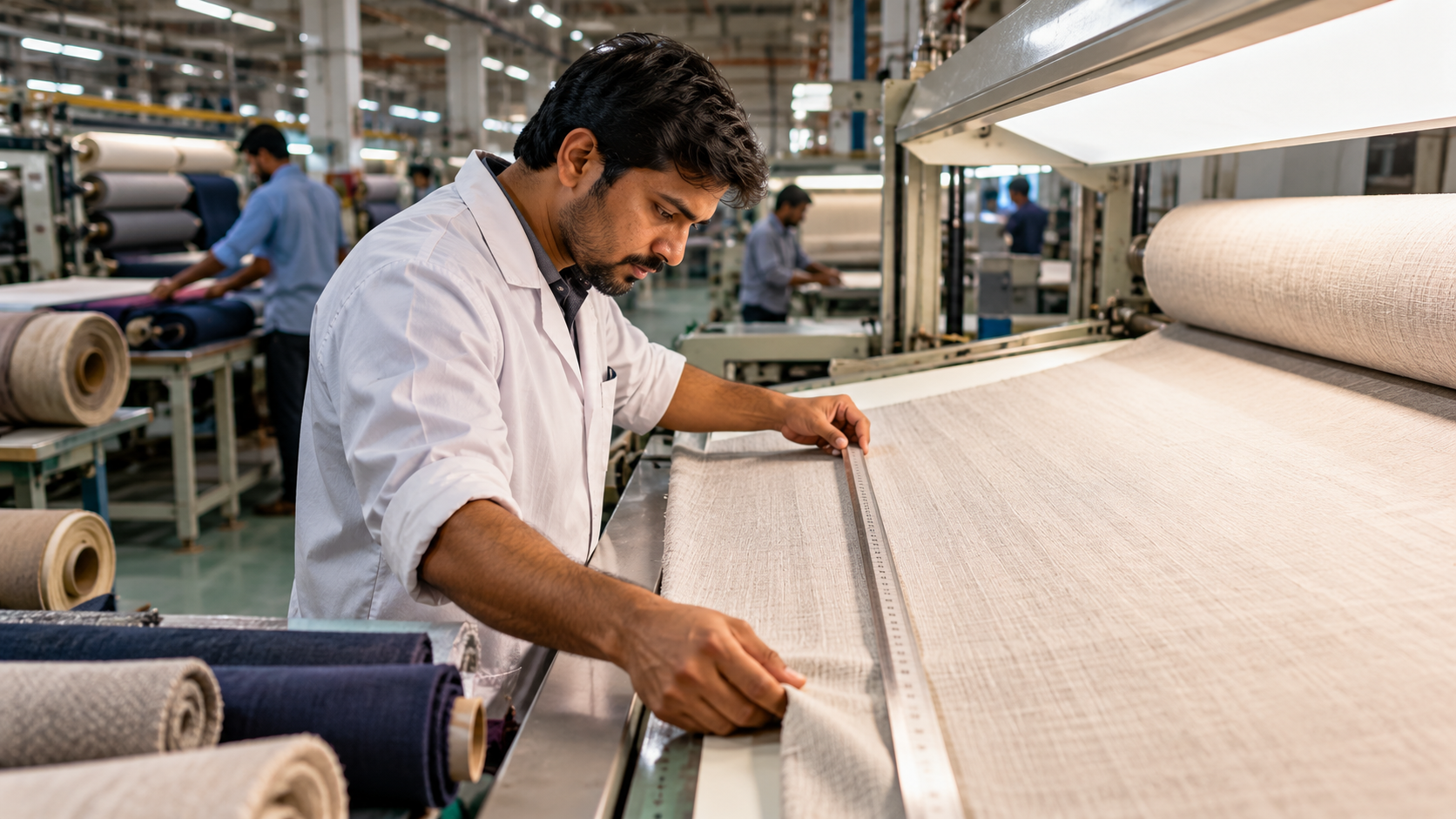
7. Plan Quality Control Before Bulk Production
Quality should not be treated as something to check only after production is finished. The quality expectations should be discussed before bulk production begins, especially when the order involves custom specifications or significant quantities. Depending on the product, quality checks may involve dimensions, composition, construction, appearance, colour, workmanship, packaging and other buyer-defined requirements. The exact inspection method should match the product and the buyer's agreed specification.
8. Understand MOQ, Pricing and Total Sourcing Cost
A textile quotation should be evaluated in context. The quoted unit price can depend on factors such as material selection, construction, quantity, colour, finish, customisation, packaging and other commercial requirements. Minimum order quantity can also vary according to the product and production process. Instead of asking only "What is your price?", buyers should try to understand what the quotation includes and which variables can change the final cost.
Questions to Clarify in a Quotation
- • What quantity is the quotation based on?
- • Is the price for a standard or customised product?
- • What specifications are included?
- • What packaging is included?
- • Are samples charged separately?
- • What are the applicable payment terms?
- • What is the estimated production timeline?
- • Which delivery or shipment terms apply?
- • Are testing or additional requirements included?
Woven Fabric
Add products to your RFQ bag and send one consolidated request to the RGH team.
Knitted Fabric
Add products to your RFQ bag and send one consolidated request to the RGH team.
Knitted Fabric
Add products to your RFQ bag and send one consolidated request to the RGH team.
9. Plan Production and Delivery Realistically
Once specifications and samples are approved, production planning becomes the next important stage. Buyers should establish realistic expectations for sampling, production, quality checks, documentation and shipment. Timelines can vary depending on product complexity, order quantity, customisation and other operational factors. Avoid building a purchasing schedule around an assumed delivery date before the production and logistics requirements have been properly discussed with the supplier.
A Simple Sourcing Timeline
- 1. Requirement preparation
- 2. Supplier evaluation
- 3. Quotation
- 4. Sample development
- 5. Sample approval
- 6. Order confirmation
- 7. Production
- 8. Quality inspection
- 9. Packing and documentation
- 10. Shipment
- 11. Delivery
10. Common Mistakes International Textile Buyers Should Avoid
- 1. Choosing a supplier only because the quotation is the lowest.
- 2. Sending an unclear product requirement.
- 3. Skipping physical sampling.
- 4. Changing specifications after production has started.
- 5. Not documenting the approved sample or specification.
- 6. Assuming every textile supplier can manufacture every type of product.
- 7. Ignoring minimum order quantities.
- 8. Not discussing quality expectations early.
- 9. Leaving packaging and labelling requirements until the end.
- 10. Building delivery schedules without allowing realistic production and logistics time.
11. A Practical Textile Sourcing Checklist
- ☐ Define the product requirement
- ☐ Confirm composition and construction
- ☐ Specify GSM, width or dimensions where relevant
- ☐ Define colour and finish requirements
- ☐ Estimate required quantity
- ☐ Identify packaging and labelling requirements
- ☐ Shortlist suitable suppliers
- ☐ Compare supplier capability, not just price
- ☐ Request samples
- ☐ Evaluate samples against the specification
- ☐ Confirm commercial terms
- ☐ Approve final specifications
- ☐ Establish quality expectations
- ☐ Confirm production timeline
- ☐ Confirm documentation requirements
- ☐ Plan shipment and delivery
12. How to Start Sourcing Textiles from India
The best way to begin is with a clear requirement rather than a vague product enquiry. Prepare your specifications, estimated quantity, target application and delivery requirements. Then approach suppliers that appear capable of supporting the product and ask focused questions about sampling, production, quality and commercial terms. If you already have a product reference, tech pack, photograph, specification sheet or sample, include it with your enquiry. This gives the supplier more context and can make the initial conversation considerably more productive.
Ready to Source from India?
Tell us what you're looking for and our team can help you explore the right textile sourcing solution.
REQUEST A QUOTE
Frequently asked questions
Q1: Why should international buyers source textiles from India?
India has a broad textile ecosystem covering different stages and categories of textile production. For buyers, this can provide access to a wide range of textile products and manufacturing capabilities. The right sourcing partner still depends on the buyer's specific product, quality, quantity and commercial requirements.
Q2: How do I find a reliable textile supplier in India?
Start by evaluating the supplier's product capability, sampling process, quality approach, communication, production capacity, commercial terms and export readiness. Request relevant samples and clearly communicate your specifications before making a final sourcing decision.
Q3: Should I request a textile sample before placing an order?
Yes. A physical sample can help you evaluate characteristics such as hand feel, weight, construction, colour, finish and suitability for the intended application before moving toward bulk production.
Q4: What information should I send to an Indian textile supplier?
Where possible, provide the product type, fibre composition, construction, GSM or weight, dimensions, colour, finish, quantity, packaging requirements, intended use, delivery requirements and any relevant reference images, samples or technical documents.
Q5: How important is MOQ when sourcing textiles?
MOQ can affect pricing, production feasibility and the suitability of a supplier for your order. Always clarify the applicable minimum order quantity before finalising the sourcing plan.
Q6: How can I request a textile quotation from India?
Prepare your product requirements and estimated quantity, then submit a detailed sourcing enquiry. Including specifications, reference material and delivery requirements can help the supplier understand the request and prepare a more relevant quotation.
Ready to source from India?
Tell us what you're looking for and our team can help you explore the right textile solution.